
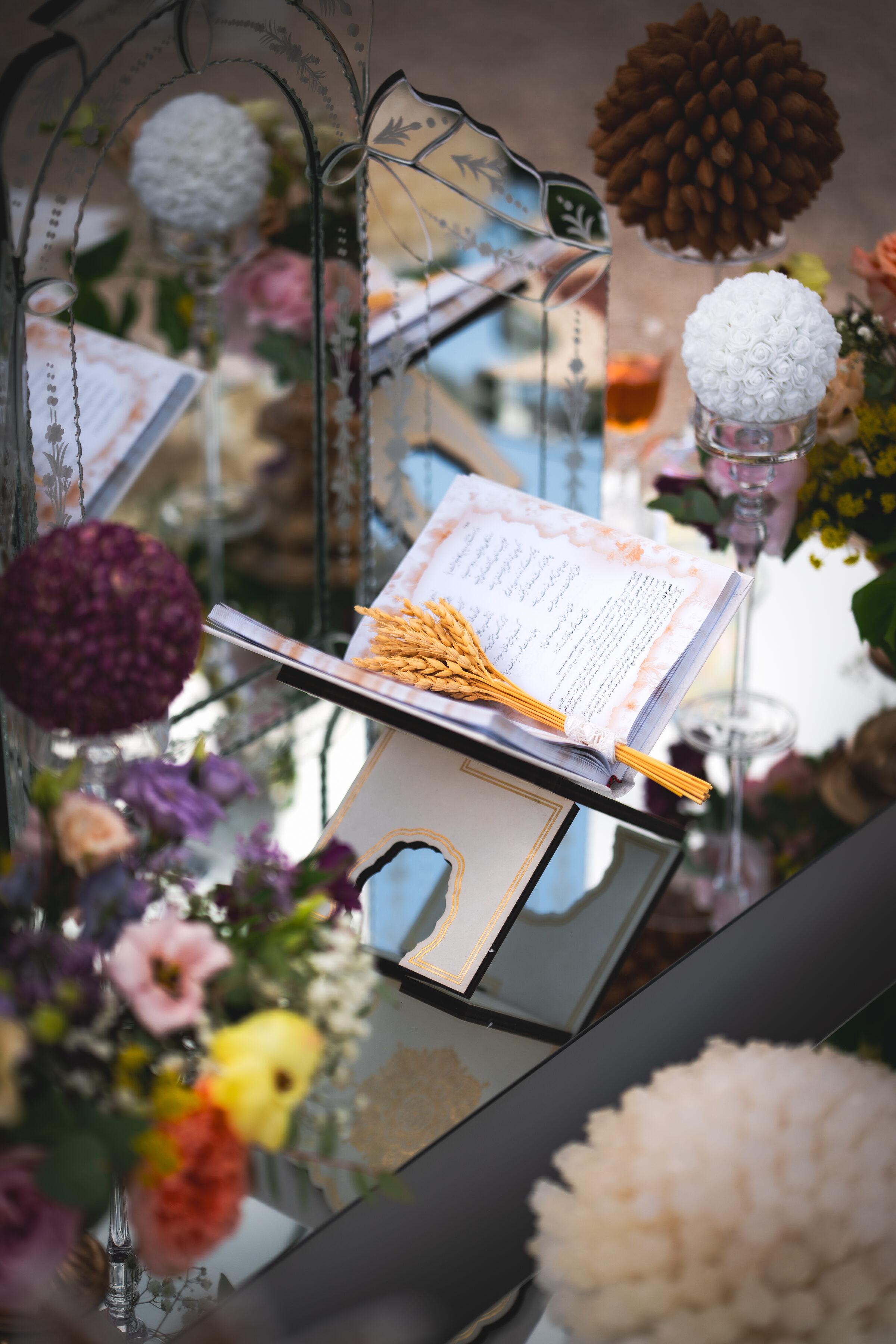
The sofreh aghd is not a decoration. This is the first thing we tell couples who come to us wanting one but uncertain of its meaning. It is a ceremony within the ceremony — a composition of objects, each carrying specific intention — and it must be understood before it can be arranged.
At the heart of a Persian or Iranian wedding, the Sofreh Aghd is the symbolic spread before which the couple sits during the aghd, or marriage-contract ceremony. Its meaning is both collective and intimate: some elements are widely recognised, while others belong entirely to a region, a faith, a family or one particular love story.
What does “Sofreh Aghd” mean?
Sofreh describes a spread or cloth laid out for a significant gathering; aghd refers to the marriage-contract ceremony. You may also encounter the names Sofre Aghd or Sofreh-ye Aghd. The term is best understood as the ceremonial spread of the union, rather than simply a wedding table.
There is no single arrangement that represents every Iranian family. The objects, readings and sequence can change across regions and generations, and according to whether a couple approaches the ceremony through religion, poetry, cultural memory or a combination of all three.
The meaning of the symbols on the Sofreh
The mirror, or āyeneh, draws light and the couple’s reflection into the ceremony. Candelabras are placed nearby for brightness, clarity and warmth. Bread, fruit, nuts and decorated eggs speak in different ways of nourishment, abundance, fertility and the household the couple is beginning to form.
Herbs, spices and esfand — wild rue — are associated with health and protection. Coins suggest prosperity. Persian sweets and the honey the couple shares express the wish that married life remain tender. During another familiar ritual, relatives rub sugar cones above the couple beneath a cloth, symbolically showering their future with sweetness.
A book may occupy an important place on the spread. For one family it is a Qur’an; for another, the Divan of Hafez, poetry by Rumi or a book with personal meaning. What matters is not uniformity, but the values and continuity that the object carries into the ceremony.
What happens during the Aghd ceremony?
The couple sits facing the Sofreh while the officiant leads the marriage-contract ceremony and invited relatives take part in selected rituals. The readings, responses and legal or symbolic role of the Aghd vary according to where the marriage is taking place and how the couple has chosen to structure it.
When two cultures meet, the Aghd often sits within a longer ceremony that also includes personal vows, civil or secular readings, music and traditions from another culture. A thoughtful order allows guests to understand what they are witnessing without turning a private family ritual into a performance or lecture.
Tradition can be personal and contemporary
A contemporary Sofreh Aghd can be visually restrained or abundant, but design should never make the symbols illegible. We begin by asking which objects the family already owns, which rituals the couple wants to keep and whether an inherited textile, mirror, book or photograph should become part of the composition.
From there, flowers, vessels, light and materials can respond to the architecture of the venue and the wider wedding design. The result should feel at home in the room while remaining recognisably rooted in the people sitting before it.
Designing a Sofreh Aghd for a wedding in France or abroad
For a destination wedding, beauty depends on logistics. The ceremony needs clear sightlines, safe candle placement, a realistic installation window and a plan for fresh herbs, fruit, sweets and fragile family pieces. The designer must coordinate with the venue, planner, florist, officiant and the relatives who will participate.
From our Paris atelier, we design and install Sofreh Aghd ceremonies across France and for selected destinations beyond. Every commission begins in the same place: a conversation about what your family understands, what your partner is learning and what the two of you want this spread to carry forward.